
🏷️ Price on Request | Packages + Tiers
🔹 Built for labs, test & Measurement, and production Networks 🔹
Contact us for a tailored soultion.






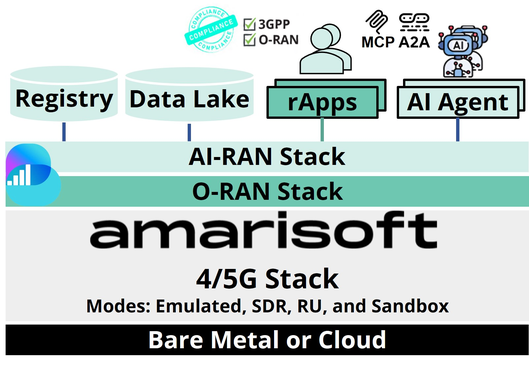
AMARI-Sphere integrates BubbleRAN’s O-RAN and AI-RAN stack with Amarisoft’s software-defined 4G/5G RAN/CN/IMS/UE foundation, known for simplicity and ease of deployment, while preserving Amarisoft’s established workflows and user experience. By combining both technologies, AMARI-Sphere enables you to design, deploy, and operate end-to-end O-RAN networks powered by AI-RAN services, from lab environments to production deployments. It supports O-RAN standardized interfaces (E2, A1, R1) for real-time monitoring, control, and coordination, and delivers AI-for-RAN and AI-on-RAN services to improve network performance and operational efficiency.
📄 AMARI-Sphere Data Sheet | 💡 BubbleRAN solutions | ▶️ Book a live demo
What is included in AMARI-Sphere?
AMARI-Sphere is delivered as an integrated stack combining:
- Amarisoft 4G/5G software stack + License Server: eNB/gNB, 4GC/5CN/IMS, UE.
- BubbleRAN RIC-Sphere stack: RICs (Near-RT + Non-RT), Proxy-E2 Agent, xApp/rApp SDKs
- BubbleRAN SMO-Sphere stack: Day 0 → Day 2+ automation, lifecycle management, slicing at scale
- BubbleRAN AI-RAN services: AI-for-RAN, AI-on-RAN, agent toolkit and catalog
Software Components
1) BubbleRAN RIC (RIC-Sphere inside AMARI-Sphere)
AMARI-Sphere includes BubbleRAN’s RIC stack (RIC-Sphere), Compliant with O-RAN architecture:
- Near-RT RIC on the RAN side (controls CU/DU/E2 nodes via E2)
- Non-RT RIC as a logical function in the SMO framework (long-term policy, analytics, AI/ML orchestration via A1 and R1)
- Proxy-E2 Agent as an E2 adaptor for Amarisoft Websocket interface and as a standalone E2 node emulation.
2) BubbleRAN SMO (SMO-Sphere inside AMARI-Sphere)
SMO-Sphere is an O-RAN compliant, cloud-native SMO built on Kubernetes leveraging the operator pattern:
- Intent-driven automation from Day 0 planning to Day 2+ operations
- End-to-end lifecycle management of multi-vendor RAN and CN, enabling design, deploy, operate, automate, and optimize networks at scale
- Third-party NF onboarding (including CU, xApps, rApps) via CDK for brownfield and greenfield deployments
3) BubbleRAN AI-RAN Services (optional extension)
AI-RAN services enable closed-loop intelligence through:
- AI-for-RAN: intelligence executed outside the RAN software (e.g., orchestration layers or rApps)
- AI-on-RAN: AI services co-located with RAN infrastructure (e.g., edge GPUaaS)
- Blueprints: RAN Optimization, AI/ML pipelines, analytics/insights, and dataset collection
- Network assistant & agent toolkit to reuse, extend, or develop telco agents
4) Amarisoft Network + UE Series with License Server (Prerequisites)
To operate the integrated solution, customers typically require:
- AMARI Floating License Server (FLS) and keys
- AMARI vRAN/eNB/gNB and 4G/5G CN/IMS software licenses (e.g., NW 200/600/2000/4000/8000)
- Optionally AMARI UE SimBox series
BubbleRAN runs the Amarisoft license server in-cluster and supports both internal and external license deployments. The license can be either purchased directly from Amarisoft or from BubbleRAN.
Hardware Options
Compute Node Options
-
Option 1: Deploy on AMARI Callbox series (Advance onwards recommended)
-
Option 2: Deploy on BubbleRAN O-Cloud with Amarisoft SW license
- Minimum 3 compute nodes (up to 8 with base license), high-performance workstation/rack servers
-
Option 3: Deploy on customized compute nodes with Amarisoft SW license (installation fee applies)
- Intel/AMD servers supporting AVX512; recommended: >16 cores, >64 GB RAM, NVMe/SSD
- Ubuntu recommended (RHEL supported)
- 1 node minimum; 3 nodes recommended for typical deployments
RF Options
- Option 1: AMARI SDR (SDR50 / SDR100 cards; USRP possible but not recommended)
- Option 2: O-RU (Split 7.2) or RRH (Split 8) supported by Amarisoft stack (vendor-dependent)
Installation Options (Choose Your Entry Point)
Option 1: AMR-RIC (Amarisoft + Near-RT RIC + xApps on bare metal)
- Keeps Amarisoft deployment and UX unchanged
- Adds O-RAN programmability (monitor/control/coordination), observability, dataset collection
- Interfaces: O-RAN E2AP, JSON/YAML config, WS API config, WebGUI
Option 2: AMR-SMO (Amarisoft + SMO in private cloud)
- Deploy Amarisoft RAN/CN/IMS/UE in Kubernetes with BubbleRAN SMO
- Keeps Amarisoft UX via CLI-in-CLI and preserved CLI/WebGUI workflows
- Best for: service/slice automation, scalable deployment, CI/CD/DevOps, data lake
- Interfaces: SMO/NMS APIs, Kubernetes APIs, data APIs
Option 3: AMR-O-RAN-AI-RAN (Full O-Cloud + O-RAN + optional AI-RAN)
- Extends Amarisoft with full O-RAN stack (Near-RT + Non-RT RIC) and optional AI-RAN services
- Best for: rApp development, policy enforcement, optimization, MLOps, analytics, dataset generation
- Interfaces: E2/A1/R1 + O1; AI-RAN: A2A, MCP, telco APIs
Benefits
| # | Benefit |
|---|---|
| 1 | Keep Amarisoft performance + UX, add O-RAN programmability and cloud-native automation on top. |
| 2 | Standards-based O-RAN control (E2/A1/R1) to reduce integration lock-in and accelerate interop. |
| 3 | Fast near-RT control loops (sub-ms to ms class) enabling practical xApp-driven optimization. |
| 4 | Day 0 → Day 2+ automation for scalable multi-cell/multi-instance deployments and upgrades. |
| 5 | Built-in observability + data lake for repeatable experimentation, benchmarking, and assurance. |
| 6 | AI-RAN ready: data → insights → policies → closed loops using agent toolkit and workflows. |
| 7 | Flexible deployment choices: bare metal for tight control, Kubernetes for agility and scale. |
Applications
| # | Application |
|---|---|
| 1 | Private 5G/6G labs and testbeds with repeatable deployment and rich observability. |
| 2 | Interoperability & regression testing for multi-vendor RAN/CN components and xApps/rApps. |
| 3 | O-RAN programmability on Amarisoft: mobility, load balancing, interference mitigation, eco-RAN. |
| 4 | Cloud-native Amarisoft at scale with slicing, multi-core connectivity, and lifecycle automation. |
| 5 | AI-RAN experimentation (dataset generation, analytics, agent-driven operations). |
Need more information ?
Check our frequently asked questions abour Amari-Sphere here below and get quick replies.
To answer your unique deployment and projects needs, we can plan a live demo, help you forward with a requirements questionnaire, and connect you with our partner ecosystem (universities, system integrators, cloud providers).
Frequently Asked Questions
1️⃣ I already bought an Amarisoft license — do I need another one?
No for the O-RAN stack on top of an Amarisoft testbed. For O-Cloud deployments, you may need to update your existing license to a license-server-compatible setup.
BubbleRAN supports running an Amarisoft license server (with the appropriate Amarisoft license) in-cluster or externally, supporting multiple license types.
2️⃣ How does my AMARI CallBox work on O-Cloud? Do I need to re-set up my Amarisoft testbed?
On O-Cloud, BubbleRAN runs Amarisoft as a cloud-native stack (containerized and orchestrated with Kubernetes). SMO auto-detects supported SDRs, and the cloud-native license server supports in-cluster or external licenses.
Not necessarily. You can add BubbleRAN’s O-RAN stack on top of an existing testbed. For O-Cloud, you typically install BubbleRAN’s custom OS on your infrastructure; the deployment can be performed remotely and includes the license server and O-RAN stack.
3️⃣ What are the benefits of Near-RT RIC for Amarisoft?
Near-RT RIC enables O-RAN compliance, interoperability with RANs from other vendors, low-latency monitoring/control loops, and reusable xApps—so xApps from other platforms can be integrated with Amarisoft RAN.
4️⃣ What overhead is introduced by O-RAN / O-Cloud / AI-RAN?
- O-RAN stack: ultra-lean; minimal compute/memory/network overhead
- O-Cloud: minimal overhead; Amarisoft runs natively in containers (no VM layer); SMO/license server/observability are lightweight microservices
- AI-RAN: minimal overhead unless local GPUs are required (then size compute nodes accordingly)
5️⃣ What are the benefits of cloud-native deployment for Amarisoft?
Cloud-native deployment enables agile deployment at scale, automated configuration, support for large networks, and seamless integration with O-RAN xApps/rApps and adjacent services.
6️⃣ What are the contact emails?
Amarisoft Sales and/or BubbleRAN Sales