🏷️ Price on Request | Packages + Tiers
🔹 Built for test & Measurement and production Networks 🔹
Contact us for a tailored soultion.






RIC-Sphere is BubbleRAN’s O-RAN compliant, interoperable RIC platform that brings fine-grain programmability, automation, and AI-driven optimization to 5G/6G Open RAN and AI-RAN deployments. It combines:
- Near-RT RIC for fast control loops down to sub-millisecond scale,
- Non-RT RIC for policies, analytics, and AI/ML orchestration,
- A Proxy-E2 Agent for legacy RAN adaptation and E2-node emulation,
- Plus a reusable ecosystem of xApps/rApps, SDKs, and DevOps workflows.
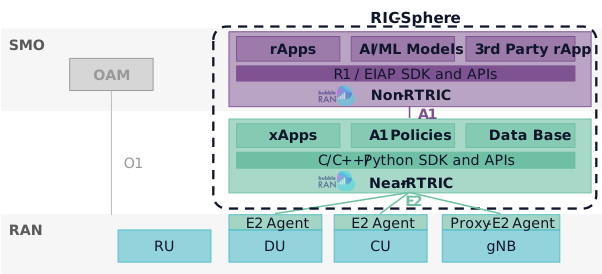
SMO-Sphere and RIC-Sphere are core building blocks of the BubbleRAN Intelligent Automation Platform. They enhance RAN performance while driving operational efficiencies through cloud-native automation and intelligence in radio access networks.
Outcome: build and validate closed-loop RAN use-cases faster (slicing, QoS/QoE, mobility, interference management, energy optimization, sensing/localization), and scale from lab experimentation to multi-vendor integration and operational trials—without changing platforms.
📄 RIC-Sphere Data Sheet | 💡 BubbleRAN solutions | ▶️ Book a live demo
What is included in the RIC-Sphere Software?
All components below are included in RIC-Sphere.
1) Non-RT RIC (policy + analytics + AI/ML orchestration)
- Latency target: 1–100 ms (control/policy timescale)
- Interfaces:
- A1 (A1AP v4.04, A1-P)
- R1 (R1AP v8.0 or Kubernetes CRDs)
- EIAP compatibility (Ericsson EIAP v6.x)
- O1 (Experimental feature)
- rApp capabilities (examples):
- Intent-driven RAN automation (monitoring, data collection, policy jobs)
- QoS/QoE optimization via A1 services
- CM/OAM optimization services
- AI-powered slice enforcement & SLA assurance
- Dev Kit: rApp SDK (C, Python)
2) Near-RT RIC (xApps + near-real-time control)
- Latency target: 300 µs – 1 ms (fast-loop control)
- Interfaces:
- E2 (E2AP v3.0)
- A1-related APIs (A1AP v4.04, A1-P)
- E2-related Open APIs
- Service Models (E2SM):
- O-RAN E2SMs: KPM v3.0, RC v1.03, CCC v3.01, LLC v1.0
- BubbleRAN E2SMs: Traffic Control (TC v0.2), Slice Control (SC v2.0), L2 Statistics (LS v2.0)
- xApp development: User + Developer SDKs (C, C++, Python)
3) Proxy-E2 Agent (bridge + emulation + legacy integration)
- Latency target: 1–10 ms (agent to RAN via WebSocket; indicative)
- Southbound: WebSocket, REST APIs, dataset-file interface
- Northbound: E2 (E2AP v3.0) + the same O-RAN E2SMs (KPM/RC/CCC/LLC)
- Modes: Test and Operational
4) Observability-ready data layer
- Supported: VictoriaMetrics / VictoriaLogs / VictoriaTrace
- Optional: MySQL, SQLite3
5) DevOps workflow & enablement ecosystem
- Agile workflow from xApp/rApp development → onboarding → closed-loop validation
- Reusable examples and labs to accelerate a first working loop (policy → E2 control → KPI validation)
- Designed for multi-vendor integration and validation with third-party test tools (e.g., RIC test suites)
Practical Use-cases

| Use-case | What it enables | Typical building blocks |
|---|---|---|
| SLA / QoS / QoE assurance | Create/update slices and enforce QoS policies per traffic class | KPM + RC/CCC + Slice Control |
| ECO-RAN | Policy-driven energy-aware configuration & resource allocation | KPM + RC + CCC |
| AUTO-RAN | Application-centric RAN slicing/association responding to spatio-temporal demand | TC + SC + LS |
| Mobility Load Balancing (MLB) | Closed-loop mobility control with target-based policies | KPM + RC |
| Interference management | Detect and mitigate interference patterns via near-RT control | KPM + RC (+ vendor extensions) |
| Localization / sensing workflows | Capture low-level signals/metrics for sensing-driven services | LLC |
- O-RAN Compliant Service Models:
KPM: Key Performance Measurement,RC: RAN Control,CCC: Cell Configuration and Control, andLLC: Low Layer Control. - BubbleRAN Custom O-RAN Service Models:
TC: traffic control,SC: Slice Control, andLS: Layer stats.
Benefits
| # | Benefit |
|---|---|
| 1 | Multi-vendor programmability via standard O-RAN interfaces (E2/A1/R1) and service models—reduce integration lock-in. |
| 2 | Fast closed loops down to sub-ms near-RT control for advanced optimization and sensing-style workflows. |
| 3 | AI-ready control plane: Non-RT policies + AI/ML lifecycle and distribution to near-RT control loops. |
| 4 | Cloud-native operations: containerized microservices for scalable deployment on-prem, bare metal, or public cloud. |
| 5 | Lower OPEX and operational complexity by standardizing automation workflows and enabling reusable xApp/rApp artifacts. |
| 6 | Brownfield + greenfield friendly with Proxy-E2 Agent and EIAP-aligned rApp integration options. |
Applications
| # | Application |
|---|---|
| 1 | O-RAN RIC R&D: develop xApps/rApps with repeatable workflows and validate with real KPIs. |
| 2 | Interoperability & conformance: multi-vendor E2/A1 integration, regression testing, and onboarding validation. |
| 3 | Private 5G/6G optimization: closed-loop automation for slicing, QoE/QoS assurance, mobility, and energy optimization. |
| 4 | AI-RAN experimentation: data → model → policy loops across Non-RT and Near-RT timescales. |
| 5 | Sensing/localization research: explore low-latency data capture and near-RT control for sensing-enabled use-cases. |
Need more information ?
Check our frequently asked questions abour RIC-Sphere here below and get quick replies.
To answer your unique deployment and projects needs, we can plan a live demo, help you forward with a requirements questionnaire, and connect you with our partner ecosystem (universities, system integrators, cloud providers).
Frequently Asked Questions
1️⃣ What makes RIC-Sphere different from other RIC platforms?
RIC-Sphere combines O-RAN compliance, cloud-native delivery, fine-grain programmability, and sub-ms near-RT control in one platform—so you can develop differentiating use-cases (slicing/QoE/optimization and sensing-style workflows) without changing stacks as you scale.
2️⃣ Why does cloud-native deployment matter for a RIC?
Cloud-native deployment supports automated rollout/upgrade, scalable DevOps cycles, and smoother integration with adjacent services and app ecosystems—helping teams iterate faster from lab trials to operational validation.
3️⃣ How does RIC-Sphere support multi-vendor interoperability?
Interoperability is achieved through O-RAN standard interfaces and service models (E2/A1/R1). O1 interfaces are also supported (Experimental feature). Validation can be strengthened using third-party RIC test tooling to support integration and regression testing.
4️⃣ How customizable is RIC-Sphere?
You can extend RIC-Sphere through custom service models, xApps (Near-RT), custom rApps (Non-RT), AI/ML model integration, and service model extensions where deeper telemetry/control is needed.
5️⃣ How fast can we get started and prove value?
Teams typically start from provided workflows, SDKs, and example apps to build a first closed loop quickly, validate interoperability, and then extend toward production-like scenarios with repeatable pipelines.
6️⃣ What business value does Sphere-RIC deliver?
RIC-Sphere helps reduce OPEX and operational complexity by standardizing RAN programmability and automation across vendors, and by reducing integration friction through reusable artifacts and consistent DevOps workflows.