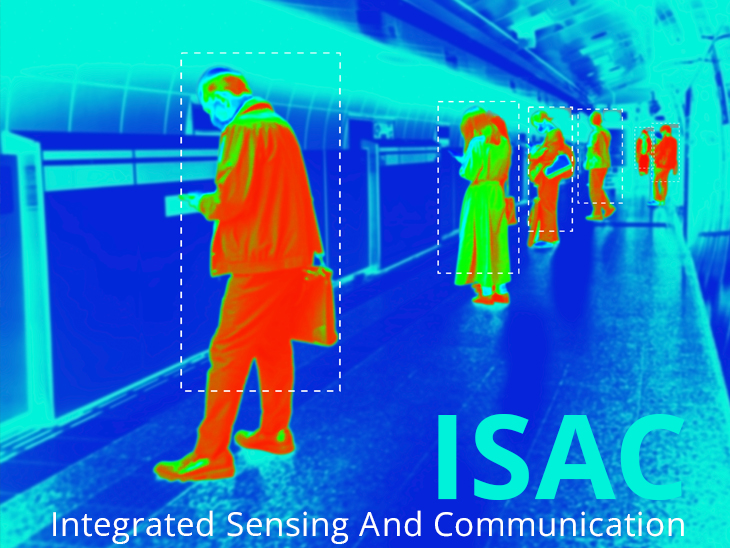
Integrated Sensing and Communication (ISAC) leverages 5G networks to simultaneously provide wireless communication and sense the surrounding environment. A key enabler of ISAC is the ability of the base station to measure how radio signals travel between devices. By leveraging these measurements, ISAC applications can detect objects, estimate device locations, and monitor environmental changes. MX-PDK empowers developers to rapidly build, integrate, and deploy ISAC applications on open, standards-based 5G and O-RAN networks, accelerating experimentation and innovation.
Leveraging the O-RAN Low Layer Control (LLC) E2 service model, xApps can gain access low-layer radio measurements such as physical-layer SRS I/Q samples. By analyzing measurements such as channel quality and signal propagation characteristics, users and developers can build intelligent sensing and localization applications using machine learning without requiring dedicated sensing hardware.
As an example, we developed an over-the-air indoor testbed using a LITEON 7.2. Radio Unit, OpenAirInterface, and a Google Pixel 7 smartphone. Four antennas connected to the RU were oriented in different directions to provide coverage across the indoor environment. The MX-PDK near real-time RIC and xApp collected and streamed the physical-layer signal data via LLC E2SM, while intelligent applications processed such measurements in real-time and can use it for different purposes such as visualization and positioning.
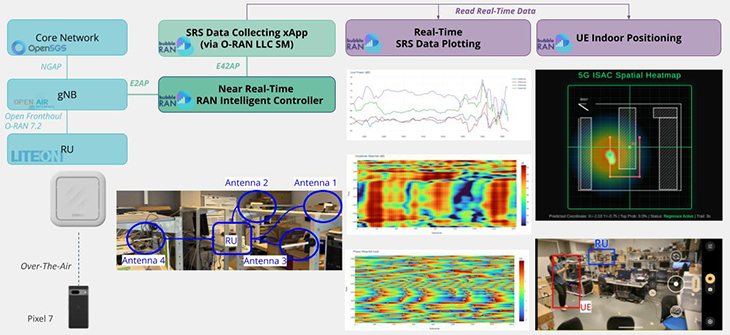
To demonstrate the ISAC capability of the MX-PDK 5G O-RAN platform, we developed three practical use-cases. They illustrate how future mobile networks can provide both communication and environmental awareness using the same wireless infrastructure.
- Real-time positioning: The first use case shows how the system can accurately estimate the indoor position of a connected device using only the 5G network, without requiring dedicated positioning hardware (e.g., cameras).
- Human and object detection: The second use case demonstrates how changes in radio signal can be used to detect when a person or object blocks the path between the device and the base station, enabling simple environmental sensing.
- Collision Avoidance: Finally, the third use case extends the concept to multiple devices, creating a real-time occupancy heatmap that highlights areas of high device density and enables collision avoidance.
These demonstrations are powered by physical-layer measurements from the 5G networks. Specifically, user devices periodically transmit Sounding Reference Signals (SRS), enabling the base station to estimate the Channel Impulse Response (CIR) and noise, which characterizes how radio waves propagate through the environment. By analyzing these channel characteristics, the three use cases enable indoor positioning, obstacle detection, and occupancy heatmap generation.
Within the MultiX project, funded by EU HORIZON-JU-SNS, we are providing the primary 5G system to the lab setup featuring O-RAN standard architecture with built-in radio sensing capabilities for object detection and localization. This system includes a RAN Intelligent Controller (RIC) implementation, enabling dynamic network optimization through modular xApps. The testbed is installed at Technikum, a state-of-the-art testing and demonstration facility located within the Siemens Technology Center (STC) in Garching, in Germany. The PoC of Multi-X project showcased at Siemens illustrates how mobile robots enhance industrial manufacturing by sensing enabled monitoring and decision-making through collection, aggregation and fusion data from ISAC-enabled sensing to provide a rich contextual information.
Use-Case 1: Real-Time Indoor Positioning
The first use case demonstrates how ISAC can accurately locate a device inside a building using only 5G radio signals. Instead of relying on GPS, which performs poorly indoors, the system learns how radio signals behave at different locations in the room. During an initial calibration phase, signal measurements are collected at known positions to create a reference map. Once trained, the system can estimate the position of a connected device in real time and display its movement on a dashboard. This approach can support applications such as indoor navigation, asset tracking, and smart factory automation.
Use-Case 2: Human and Object Detection
The second use case shows how a 5G network can detect changes in its environment without using cameras or dedicated sensors. As people or objects move between the base station and a connected device, they alter the propagation of the radio signals. By continuously monitoring these signal variations, the system can identify when an obstruction appears and immediately trigger an alert. This demonstrates how existing communication infrastructure can also function as a sensing system, making it suitable for applications such as security monitoring, occupancy detection, or smart building management.
Use-Case 3: Heatmap and collision avoidance
The third use case demonstrates how ISAC can monitor the distribution of multiple connected devices in real time by generating a dynamic occupancy heatmap. As devices move throughout the environment, the system continuously estimates their locations and highlights areas where they begin to cluster. When several users or devices come close to one another, these regions appear as high-density zones on the heatmap, indicating potential collision risks. This real-time spatial awareness can support applications such as autonomous robots in warehouses or factories, and smart buildings, where identifying congested areas helps improve safety, optimize movement, and prevent collisions.
Rapid prototyping of ISAC applications with MX-PDK
These demonstrations were built using the MX-PDK, a development platform for building and deploying O-RAN applications on top of 5G networks. By exposing real-time lower-layer radio measurements through the standardized O-RAN Low Layer Control (LLC) service models, MX-PDK enables developers to rapidly prototype, validate and deploy advanced applications without modifying the underlying network architecture.
Whether you are exploring ISAC or other radio intelligence applications, our MX-PDK platform, its DevKit and xApp/rApp catalog provide you with an inclusive foundation to accelerate innovation from research to real-world deployment. Contact us to discuss your ideas and discover how MX-PDK can help bring them to life.
ISAC artifacts and useful links
ISAC xApp and dataset are downloadable via Telcofabric portal:
Credits
Learn more
-
Watch the full ISAC demo video here
-
Read Publication Uplink SRS-based real-time indoor localization system over OpenAirInterface