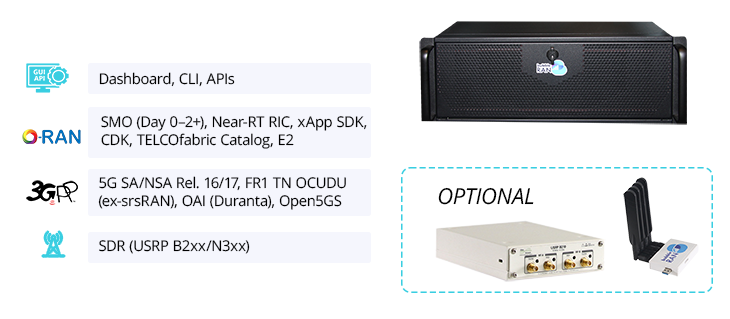
🏷️ €19,900 (+€4,000 for the OTA Pack)
Single-node O-Cloud, MX-PDK software license, and one year of updates and support


MX-PDK LAB gives students, educators, and engineers a complete, licensed, and validated cloud-native 5G and O-RAN lab on a single server. It is reproducible, extensible, and ready for hands-on learning, applied research, and small-scale PoCs.
It comes with a pre-installed BubbleRAN 5G and O-RAN environment. Unbox it, power it on, and deploy your first end-to-end 5G network, without Kubernetes bring-up, dependency hunting, or a lengthy integration project.
What makes MX-PDK LAB different
- Interact: Use an all-in-one MX-UI and CLI to deploy, observe, operate, and troubleshoot your lab.
- Design: Build multi-vendor 5G networks with an O-RAN-compliant SMO for cloud-native automation, plus xApps using multiple service models, including KPM, RC, CCC, and LLC.
- Extract: Collect and process KPIs, logs, configurations, packet traces, and datasets, including Wireshark traces.
- Experiment: Run repeatable experiments with reproducible configurations and comparable results.
- Support: Stay current with long-term support and regular software updates, see our release history.
What can you do with MX-PDK LAB?
- Design and deploy end-to-end emulated multi-vendor RAN and core network blueprints with the BubbleRAN O-RAN-compliant SMO.
- Reuse and develop O-RAN-compliant xApps with the BubbleRAN xApp SDK and catalog.
- Learn hands-on in a pre-integrated 5G lab covering the SMO, near-RT RIC, E2, and xApp SDK.
- Move over the air with the optional OTA Pack, and connect compatible commercial 5G devices and smartphones.
- Build PoCs and prototypes and showcase live demos.
What arrives in the box?
MX-PDK LAB hardware
One pre-installed workstation node, running the BubbleRAN O-Cloud with optimized Kubernetes, device discovery, Cilium networking, and eBPF-based observability.
MX-PDK LAB software
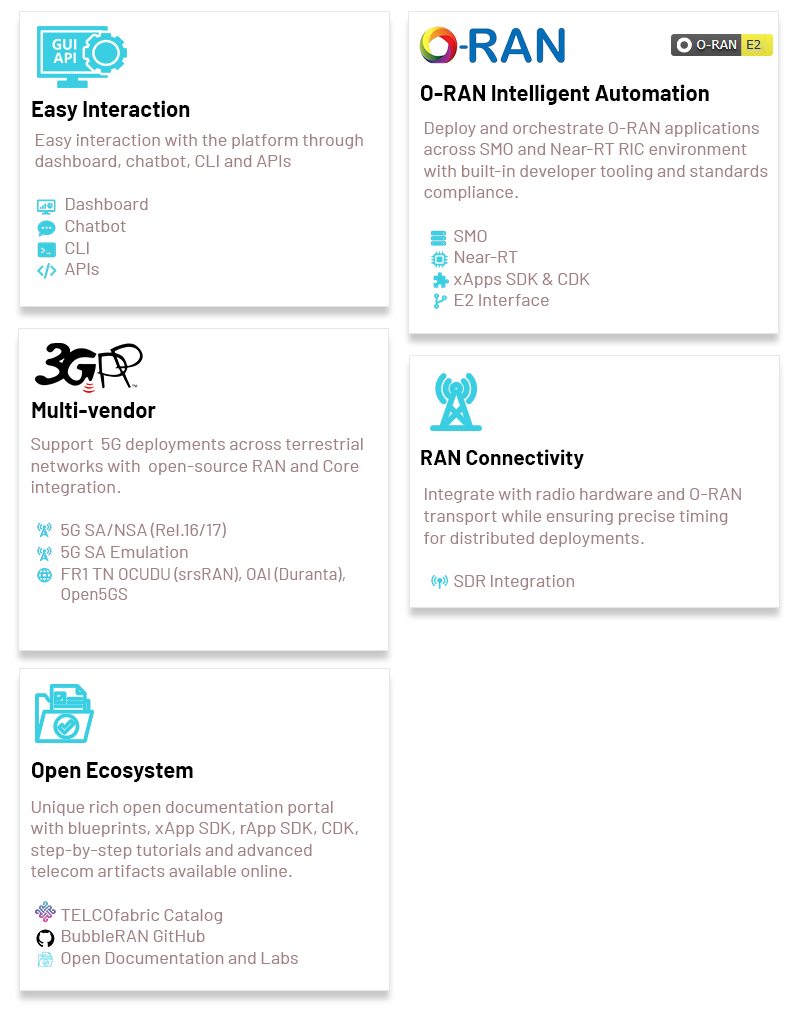
MX-PDK LAB support and software updates
The MX-PDK software license includes one year of software updates and technical support, with access to a chat channel, ticketing system, and open documentation. Tailored training is also available on request.
Your day-one blueprint
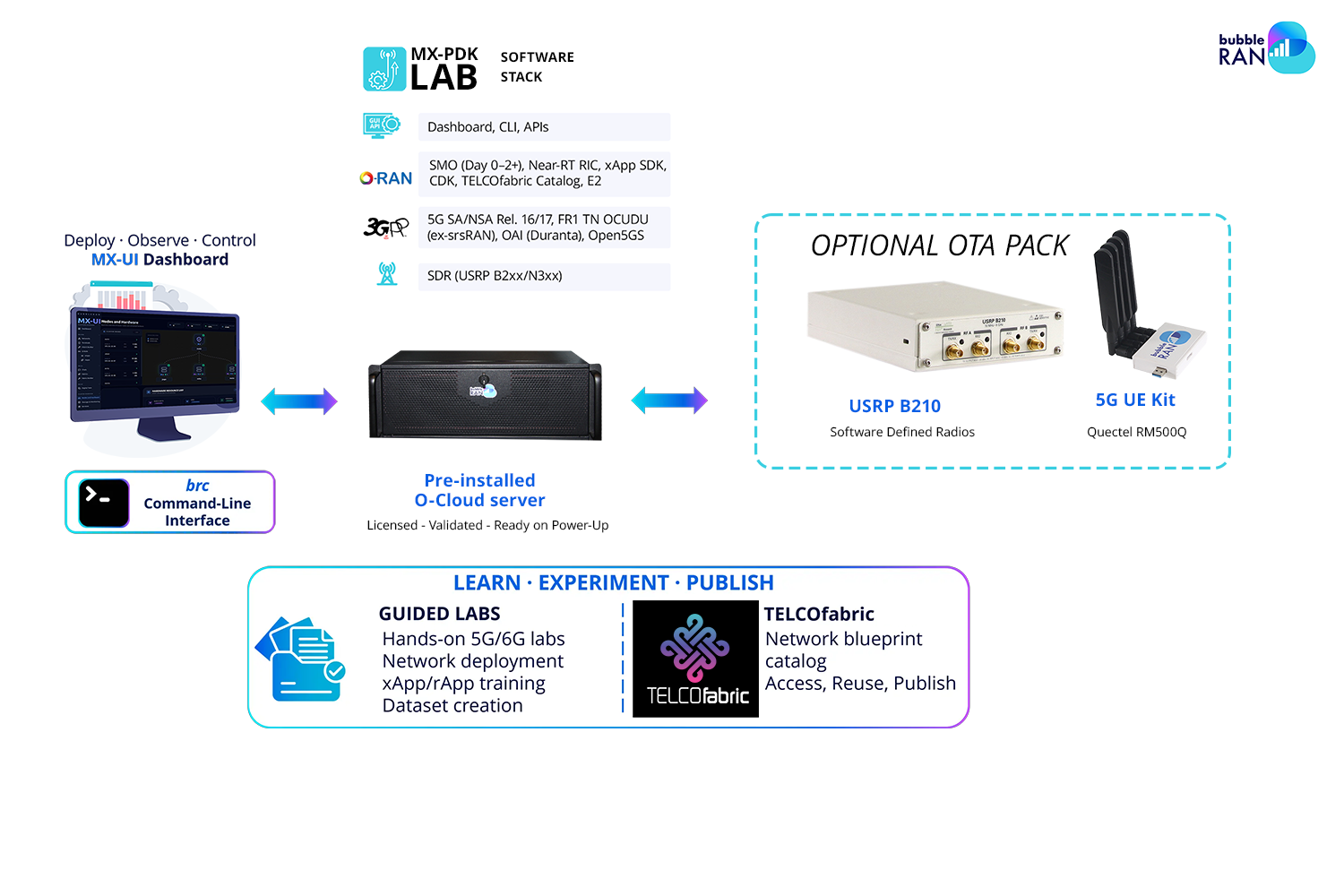
Deploy an emulated multi-vendor 5G network out of the box with up to four soft UEs. Add the OTA Pack to move from simulation to live RF and bring up a real 5G network over the air. Develop, run, observe, and publish your xApps using the same workflow. Or, start from any blueprint in the TelcoFabric portal and deploy it from the UI or the command line.
bash$ git clone https://github.com/bubbleran/blueprints && cd blueprints
bash$ brc install network network/OAI/usrp/04-5g-sa-usrp-oran-xapp.yaml
bash$ brc install terminal network/Terminals/terminal_quectel.yaml
bash$ brc observe network              # cells, the attached UE, RIC and xApps
bash$ brc extract dataset kpm          # export real over-the-air measurements
| Element | What gets deployed |
|---|---|
| Access | OAI monolithic gNB on the USRP B210, 5G SA, band n78 at 3.6 GHz, 40 MHz with 30 kHz subcarrier spacing |
| Core | OAI 5G core, AMF, SMF, and UPF, with an eMBB slice on PLMN 00101 |
| Terminal | The Quectel RM500Q, attaching over the air as a commercial UE |
| RIC | FlexRIC near-RT RIC with a monitoring xApp collecting MAC, RLC, PDCP, GTP, slice, and KPM metrics |
| Data | Measurements stored directly in the platform metrics store, ready for Grafana visualization and brc extract dataset |
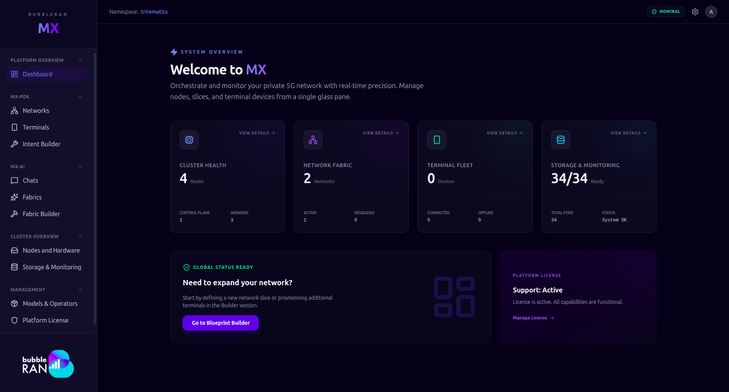
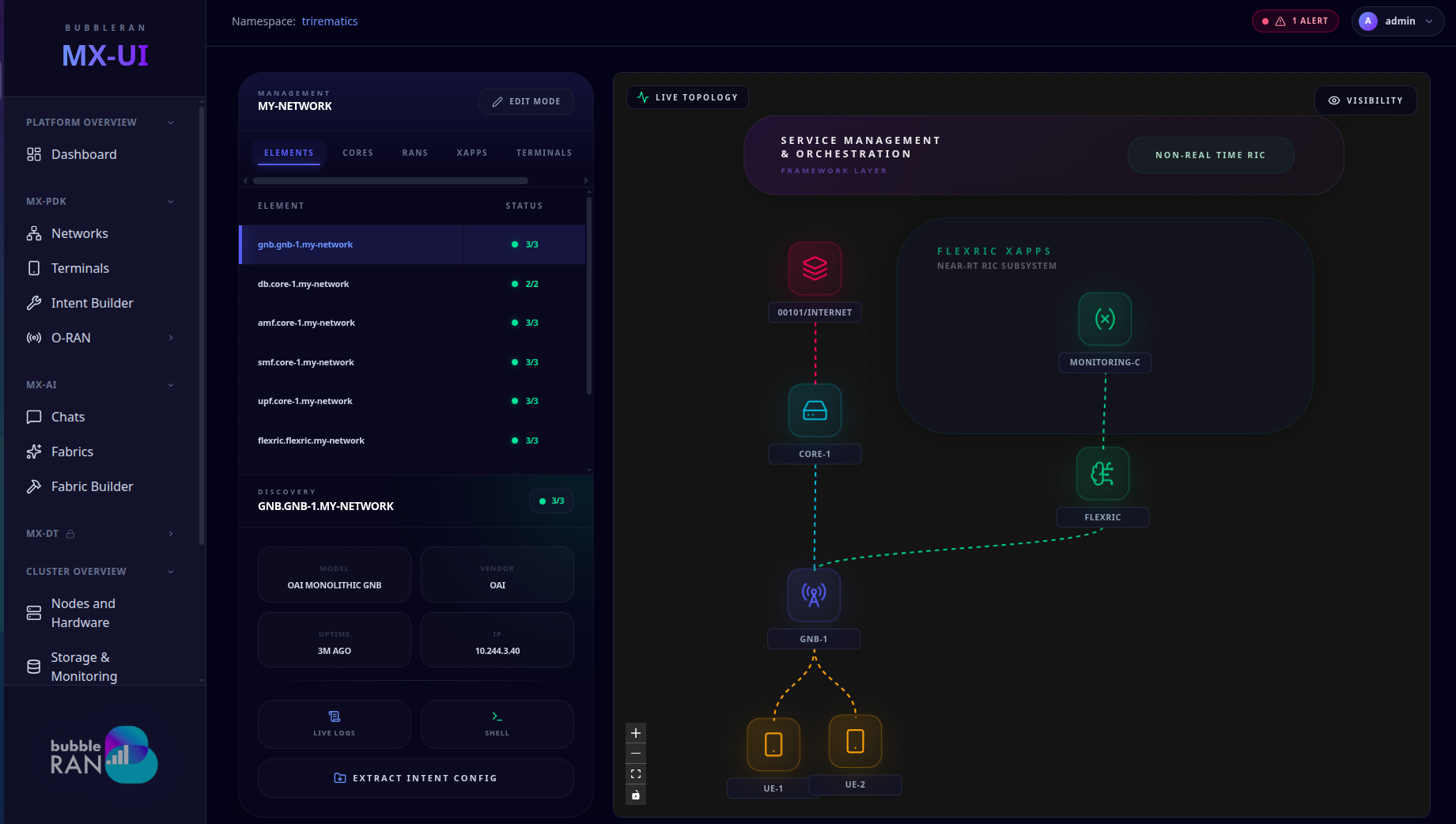
MX-UI gives you an immediate view of your cluster state, including health, active networks, the terminal fleet, and pod status in one place.
MX-UI visualizes the topology you just deployed, including the gNB, core network functions, near-RT RIC, monitoring xApp, and attached UEs, with live status for every element. Select any component to access live logs, open a shell, or extract the running configuration as an intent.
Without the OTA Pack, the same blueprint runs against the RF simulator (network/OAI/rf-sim/03-5g-sa-rfsim-oran-xapp.yaml) with soft UEs. You can develop in simulation first, then move over the air when you add the radio. The band, bandwidth, slice configuration, and your own xApps remain fully configurable, using the same E2 indication workflow.
From lab to infrastructure
Scale the same environment as your needs grow, from a single lab bench to a multi-node O-RAN or AI-RAN testbed.
| Next step | What it adds |
|---|---|
| OTA Pack (+€4,000) | USRP B210 + Quectel 5G device, adding over-the-air experimentation to the kit you already have. |
| MX-PDK O-RAN | A second node, a LITEON FlexFi Radio Unit, and a PTP fronthaul fabric, enabling a real O-RAN 7.2 split plus observability agents. |
| MX-PDK AI-RAN | A third node and a second Radio Unit for mobility between two live cells, plus the agentic AI-RAN suite and BAT Agent DevKit. |
| MX-PDK CAMPUS | Enterprise compute, outdoor and campus radios, GPU acceleration, and the Network Digital Twin. |
The network blueprints and xApps you build on MX-PDK LAB run unchanged across the MX-PDK range. Compare the range →
Who it is for
- Universities and training centers: An easy-to-use, extensible 5G teaching lab on one machine, with lab manuals and guided xApp exercises.
- Research teams: A validated baseline for master’s students, teaching assistants, and researchers starting with O-RAN, without spending months on stack integration.
- Applied R&D teams: A practical environment for xApp development, hands-on experimentation, and small-scale PoCs.
Scale and 5G/6G capabilities
MX-PDK LAB runs the same core MX-PDK feature set as our multi-node platforms, sized for a single O-Cloud node. Everything below is included in the base bundle unless otherwise noted.
5G/6G radio and network
| Capability | MX-PDK LAB |
|---|---|
| 5G stack | OpenAirInterface (R2.4.0), OCUDU (R24.06), and Open5GS, with 3GPP Release 17 support, including OCUDU UE and OAI UE soft terminals |
| Deployment modes | Standalone (SA) and Non-Standalone (NSA), monolithic gNB or CU/DU split |
| Spectrum | All TDD bands in FR1, limited TDD in FR2, with FR1 over the air using the OTA Pack |
| Bandwidth | Up to 100 MHz per cell and bandwidth part |
| Modulation | 256QAM in downlink and uplink |
| MIMO | 2x2 over the air with the OTA Pack, up to 8x8 DL / 2x2 UL on the platform |
| Mobility | Xn, NG, and inter-DU handover |
| Interfaces | E2, F1, NG, Xn, plus 7.2a or 8 fronthaul when an O-RU is added |
| O-Cloud | 1 node, Kubernetes (Kubeadm), Cilium CNI with Multus, Harbor registry, eBPF observability |
| Emulated networks | Up to 1 gNB + 4 soft UEs, OCUDU UE and OAI UE, with channel models |
| Over-the-air 5G | Available with the OTA Pack, USRP B210 + Quectel RM500Q |
O-RAN programmability
| Capability | MX-PDK LAB |
|---|---|
| Near-RT RIC | 300 µs to 1 ms control loop; E2AP v3.0 |
| E2 service models | KPM v3.0, RC v1.03, CCC v3.01, LLC v1.0, plus BubbleRAN Traffic Control, Slice Control, and L2 Statistics |
| xApp capabilities | Performance measurement and traffic steering, handover control, RAN reconfiguration, interference detection, sensing from SRS I/Q samples |
| Development kits | xApp SDK (C, C++, Python) and CDK, plus the TelcoFabric xApp catalog |
Automation, observability, and operations
| Capability | MX-PDK LAB |
|---|---|
| SMO/OAM operations | Day 0 in 1 to 5 s, Day 1 in 1 to 30 s, Day 2+ in 1 to 75 s |
| Northbound | Kubernetes CRDs (YAML), REST API, BubbleRAN CLI (brc) |
| Lifecycle scope | Resource discovery, NF onboarding, service design, scheduling, deployment, configuration, reconfiguration, testing, and upgrades |
| Observability | Multi-source data lake with RAN statistics, logs, traces, infrastructure usage, and energy consumption, plus Grafana dashboards |
| Security | RBAC, network isolation, signed rootless artifacts, SBOM |
| Growth path to 6G | AI-RAN workflows, including AI-for-RAN and AI-on-RAN, plus ISAC sensing via MX-AI, and Digital Twin scenarios via MX-DT |
Ready to start?
- Explore deployment blueprints and sample networks
- Follow the guided labs
- Learn the BubbleRAN CLI (
brc) - See MX-PDK LAB live, book a demo