
🏷️ Price on Request | Packages + Tiers
🔹 Built for test & Measurement and production Networks 🔹
Contact us for a tailored soultion.






SMO-Sphere is an O-RAN–compliant, cloud-native Service Management and Orchestration (SMO) platform designed as a declarative, intent-driven intelligent automation framework built on Kubernetes. It functions as an end-to-end Network Management System (NMS), enabling full lifecycle management across RAN, Core, and Edge domains, from Day 0 planning to Day 2+ operations. SMO-Sphere automates and optimizes network and slice management at any scale, helping operators reduce operational complexity, accelerate service deployment, and minimize vendor lock-in.
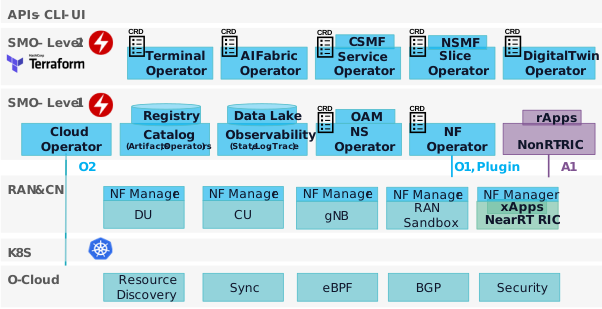
SMO-Sphere and RIC-Sphere are core building blocks of the BubbleRAN Intelligent Automation Platform. They enhance RAN performance while driving operational efficiencies through cloud-native automation and intelligence in radio access networks.
💡 Getting started is simple:
#Deploy a 5G O-RAN network in a single command
bash$ brc install network 5g-oran.yaml
# Enfore an rApp policy from the catalog
bash$ brc install policyjobs premium-sla-rapp.yaml
# Observe all the elements installed on your network
bash$ brc observe
# Extract network data from the last 5 days
brc extract dataset all -- -start 5d
📄 SMO-Sphere Data Sheet | 💡 BubbleRAN solutions | ▶️ Book a live demo
What is included in the SMO-Sphere Software?
SMO-Sphere delivers a complete O-RAN Compliant Kubernetes-native automation stack.
1) Composition Model (CM): Vendor Recipes Without Site Lock-In
A Composition Model is published as Kubernetes Custom Resources (CRs) where Vendors provide the “recipe”, and Operators retain full deployment intent and control. These CRs defines NF images and configuration plugins, roles and placement constraints, hardware/resource dependencies, logical entities such as monolithic or disaggregated RAN.
Example: Vendor-A CU-DU and Vendor-B gNB composition models.
2) Blueprint: Operator Intent for Network Services
A Blueprint encapsulates operator intent as Kubernetes CRs from Day 0 planning, executed in Day 1 deployment, and updated in Day2+ Ops. These CRS define parameters and configurations for the composition Models used, assigns parameters and topology, defines deployment targets and service profiles.
Example: a multi-vendor 3-cell network with shared CU, multiple DUs, and per-cell ARFCN configuration.
3) NF Operator (VNFM-like): Lifecycle of Individual Network Functions
Maps workload definitions into Kubernetes primitives (Pods, Deployments, Services) and automates provisioning and configuration , scaling and healing, lifecycle management of individual NFs
4) NS Operator (NFVO/OAM-like): End-to-End Network Service Automation
Provides full logical network lifecycle management with built-in fault management, configuration management, performance management, security management.
Example: Automates 5G O-RAN service from Day 1 deployment to Day 2+ operations.
5) Cloud Operator & Resource Discovery (O-Cloud Integration)
Handles discovery of heterogeneous compute/network resources including RU/GPU integration, time synchronization, optimized data plane with BGP, and cluster security.
6) Observability + Multi-Source Data Lake
SMO-Sphere provides a unified telemetry plane for NF/NS statistics, metrics/logs/traces/alarms, infrastructure resource utilization and energy consumption, and dataset export for analytics and AI pipelines. In addition, it exposes tools and command lines for dataset creation, packaging, and exporting.
7) A clatalog of Level-2 Operators for Slicing, AI, and Experimentation
- Service Operator: operatoring end-user/vertical applications and/or services.
- Slice Operator: renders 3GPP slice blueprints based on service profile and submit to NS Operator.
- AIFabric Operator: deploys AI-for-RAN / AI-on-RAN services and orchestrates multi-agent workflows
- DigitalTwin Operator: replicates in realtime the physical networks in different sandboxed network for what-if analysis or experimentation
- Terminal Operator: manages UE lifecycle and provisions UE information into the 5GC
Feature Sets (Day 0 → Day 2+)
| Phase | Latency | Examples |
|---|---|---|
| Day 0 | 1–5s | discovery, onboarding, planning |
| Day 1 | 1–30s | scheduling, deploy, configuration |
| Day 2+ | 1–75s | reconfig, test, upgrade, observability |
Benefits
| # | Benefit |
|---|---|
| 1 | Open & interoperable: aligned with O-RAN and 3GPP management principles |
| 2 | Vendor-agnostic automation via Composition Models + Blueprints |
| 3 | Intent-driven lifecycle from Day 0 → Day 2+ with fewer manual steps |
| 4 | Cloud-native reliability through Kubernetes Operator reconciliation |
| 5 | AI-ready and data-driven with built-in data lake and observability |
| 6 | Brownfield-friendly onboarding via CDK + EIAP coexistence |
Applications
| # | Application |
|---|---|
| 1 | Multi-vendor Open RAN rollout with repeatable automation |
| 2 | Continuous upgrades, reconfigurations, and reconciliation |
| 3 | Slice lifecycle management tied to service intent |
| 4 | Interoperability & regression labs with unified observability |
| 5 | AI-RAN pipelines: dataset export, model lifecycle, closed-loop ops |
Need more information ?
Check our frequently asked questions about SMO-Sphere here below and get quick replies.
To answer your unique deployment and projects needs, we can plan a live demo, help you forward with a requirements questionnaire, and connect you with our partner ecosystem (universities, system integrators, cloud providers).
Frequently Asked Questions
1️⃣ What makes SMO-Sphere different from other SMO platforms?
SMO-Sphere combines O-RAN + 3GPP alignment with a Kubernetes-native, intent-driven automation model. It brings the following key differentiators:
- Decouples Composition Model (CM) from deployment, enabling vendor-agnostic network “recipes” and reusable automation
- Kubernetes Operator-based lifecycle for repeatable installs, upgrades, and rollback-friendly operations
- Third-party NF onboarding via a Container Development Kit (CDK), supporting both brownfield and greenfield deployments
- Built-in observability and multi-source data lake for SLA assurance, analytics, and closed-loop automation
- Northbound EIAP compatibility enabling coexistence with Ericsson Intelligent Automation Platform
The key distinction is its Composition Model + Blueprint approach that decouples vendor recipes from deployment intent—reducing integration friction and enabling repeatable operations.
2️⃣ What are the benefits of cloud-native deployment?
Cloud-native deployment enables agile DevOps cycles at scale, automated lifecycle operations (deploy/upgrade/rollback), and seamless integration with observability and data platforms. The Kubernetes Operator pattern improves reliability and repeatability from lab validation to production trials.
3️⃣ How does SMO-Sphere support multi-vendor interoperability?
SMO-Sphere supports multi-vendor operations through O-RAN/3GPP-aligned management principles, standard interfaces, and vendor-agnostic modeling (Composition Models). It also supports onboarding of third-party NFs via CDK workflows for both greenfield and brownfield environments.
4️⃣ What can be customized or extended?
SMO-Sphere is extensible at multiple layers:
- CRDs for composition, intent, policy, and operational workflows
- operators/controllers for new vendors, new workflows, or site-specific integrations
- observability/data export pipelines and northbound integrations (REST/O1/RedFish where applicable)
5️⃣ How fast can a customer get started and prove value?
Teams typically start using reusable Composition Models and Blueprints to deploy a baseline network quickly, then add Day 2 workflows (upgrade/reconfig/observability) and validate outcomes through dashboards and exported datasets.
6️⃣ What business value does SMO-Sphere deliver?
SMO-Sphere reduces OPEX and operational complexity by standardizing lifecycle automation across multi-vendor RAN/CN environments and providing an end-to-end service view. It accelerates service rollout while reducing vendor lock-in risk.