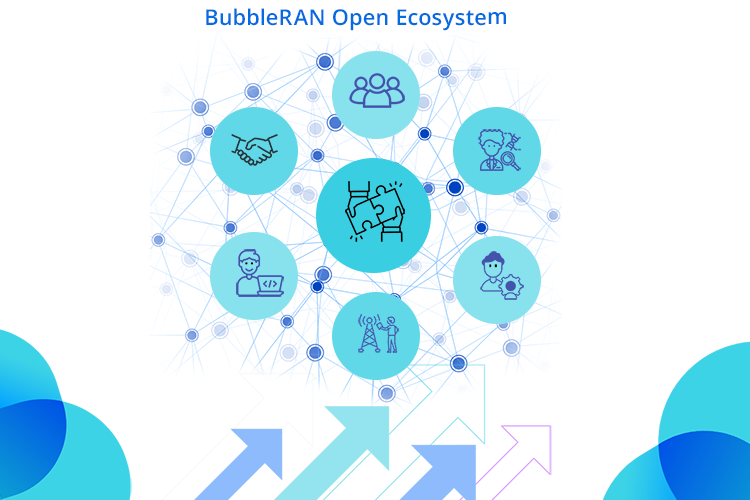
Telecom innovation is too broad and too fast-moving for any single organisation to master every layer alone. Radio, core, cloud, AI, automation and applications evolve through different communities and technology ecosystems. The strength of openness comes from connecting those capabilities.
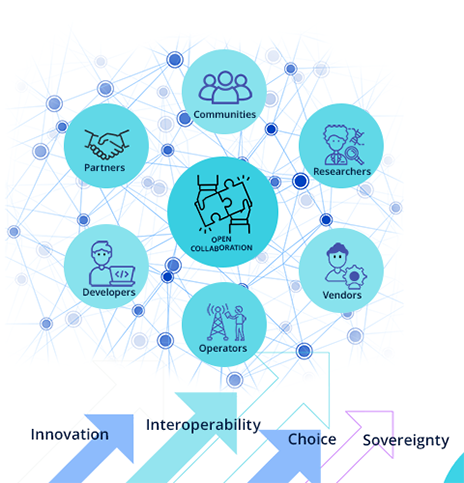
At BubbleRAN, we see open collaboration as a force multiplier: researchers create new ideas, developers turn them into software, communities improve them, vendors integrate them, operators expose real operational needs, and partners help validate and scale them. The result is faster innovation but also greater interoperability, more customer choice and stronger technological sovereignty.
The force of an open community
A healthy open ecosystem creates value because knowledge and engineering flow in more than one direction. Open collaboration connects different stakeholders as a community to keep resources open and adaptable preventing any entity to turning it to a propriety asset.
Each participant brings something different:
- Researchers explore new ideas and architectures.
- Developers and communities build, improve and maintain reusable technologies.
- Vendors and partners integrate complementary capabilities and bring them closer to real use cases.
- Operators and enterprises bring operational requirements, constraints and deployment experience.
When these groups can collaborate through open interfaces and shared technologies, innovation becomes easier to reuse and improve instead of being repeatedly rebuilt in isolation.
Turn openness into real choice
Open source alone does not automatically create interoperability or freedom of choice. Source access enables inspection and adaptation within the applicable licence. Open standards define common interfaces. Modular architectures make substitution possible. Integration and validation determine whether these choices actually work in practice.
That is why we make a distinction:
Openness without engineering creates optionality on paper. Openness with engineering creates operational choice.
Multi-vendor integration and reproducible validation provide evidence about supported combinations, dependencies and the effort required to evolve a system. This allows customers to make technology choices with better visibility into their alternatives.
Engineering focus on differentiation
Rebuilding mature software consumes engineering effort that could instead be used to develop a new service, a better optimisation method or a capability that differentiates a business. We favour open standards, open APIs, interoperability and upstream collaboration where they strengthen the broader ecosystem. We invest in BubbleRAN IP where customers need additional value, including multi-vendor integration, automation, AI-driven optimisation, orchestration, observability, lifecycle management, validation tooling and production support. The purpose is not to remove commercial differentiation. It is to place differentiation where it creates the most value.
BubbleRAN therefore follows a deliberate model:
Open where it creates ecosystem value. Differentiate where it creates customer value.
Make technological sovereignty operational
Technological sovereignty is not achieved by source-code availability alone. It also depends on the ability to understand dependencies, develop expertise, secure and maintain critical technologies, and choose how infrastructure evolves. Open source contributes to sovereignty when organisations have the engineering capability to integrate, validate, operate and sustain it.
This is particularly relevant for Europe. A strong European telecom ecosystem needs more than strong research or strong open-source communities in isolation. It needs the capacity to convert shared innovation into sustainable products, expertise and infrastructure. Open collaboration helps create that capacity by distributing knowledge, reducing unnecessary dependence on closed interfaces and enabling more actors to contribute to the technology stack. We are delighted to witness that this mindset has shifted to a foundation pillar of European (and global) tech policy.
Sustainable Collaboration
A sustainable open-source model does not require every layer to be open. Commercial products and services finance the integration, maintenance, security, lifecycle support and specialised engineering required to keep shared technologies useful over time. Upstream collaboration, in turn, keeps the common foundation healthy and reduces unnecessary divergence. This creates a positive cycle between community innovation and industrial value.
TelcoFabric portal that we launched in March 2026, extends this idea by giving the telecom community a place to publish, discover, reuse and validate artifacts such as xApps, rApps, AI agents, models, datasets, benchmarks and blueprints.
Customers and partners work with us because we make complex telecom technologies useful, interoperable and dependable, not because they are locked into a closed stack. That is where openness becomes a competitive advantage.
Further reading
- Visit TelcoFabric portal - telco artifacts for faster innovation
- Compare our products dedicated to forward looking telco R&D - MX-PDK family
- Contact us today to discuss how your teams can benefit from our openness strategy