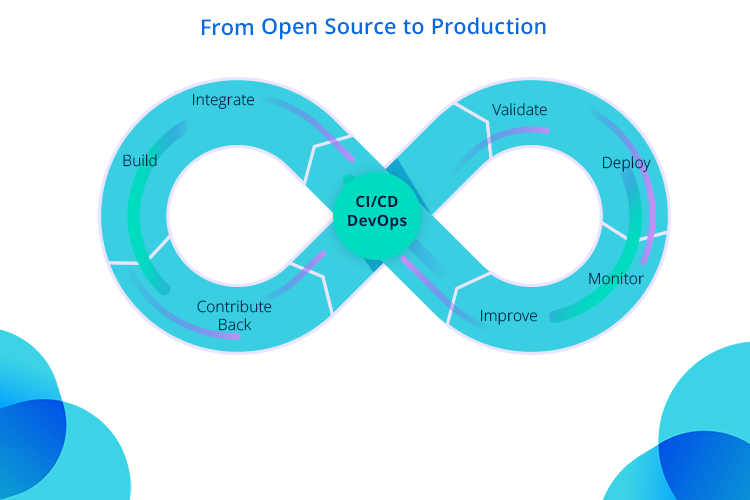
A promising telecom technology can work in a research project or demonstration and still be far from production. It must integrate with the chosen RAN and core, run on the target infrastructure, be validated under realistic conditions, expose useful diagnostics and remain maintainable as its dependencies evolve. BubbleRAN works across that gap. Our approach combines open-source foundations with continuous engineering, CI/CD and DevOps principles to create a repeatable loop between innovation and operation from building reusable software to contributing back useful improvements.
Make production a loop, not an endpoint
In telecom, deployment is not the end of engineering. Networks, software dependencies, hardware, applications and operational requirements continue to evolve. Continuous Integration (CI), Continuous Development (CD) and DevOps create the continuous engineering loop that moves open-source innovation towards production and brings operational learning back into the next development cycle.
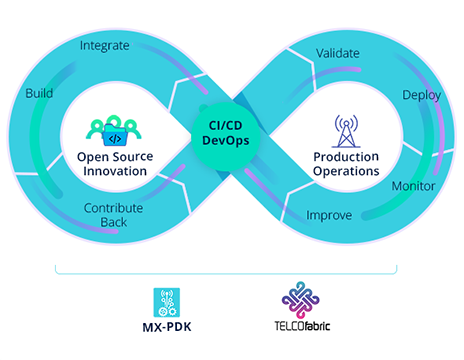
On the left side of the loop, open-source communities and R&D generate software, ideas and reusable building blocks. In the centre, continuous integration, testing and automation create repeatability. On the right, deployment and operations generate evidence about behaviour under real conditions. Monitoring and feedback then drive improvement, while broadly useful changes can flow back to upstream projects and the wider ecosystem. Production is not the end of open source. It closes the loop.
Strong open-source foundations
Open source is foundational to our MX-PDK product family. Its common 5G software foundation includes OpenAirInterface, OCUDU and Open5GS, alongside other open-source and commercial technologies across RAN, Core, Cloud, O-RAN and AI.
BubbleRAN adds the engineering required to make these components work as a coherent system: deployment automation, configuration, integration, observability, validation, lifecycle management, development tools, documentation and support. The value is not in replacing open source, but in industrialising it, connecting it and making it usable at scale.
CI/CD and DevOps to create repeatability
The principles of CI/CD and DevOps are particularly valuable in telecom because they turn complex integration work into a repeatable engineering process.
- Build reusable software and configurations from controlled sources.
- Integrate RAN, Core, Cloud, O-RAN, AI and infrastructure components.
- Validate functionality, interoperability, performance and expected behaviour.
- Deploy through automated and reproducible workflows.
- Monitor the system through observability and operational data.
- Improve software, configurations and automation based on evidence.
- Contribute back broadly useful improvements where appropriate.
Not every telecom environment can or should be updated like a web application. Production changes still require the appropriate qualification, controls and operational acceptance. The objective is to apply continuous-engineering principles where they improve reproducibility, traceability and confidence.
MX-PDK: Production & Execution
Our MX-PDK platforms provide the execution environments in which open-source and commercial technologies can be integrated, developed, tested and operated.
MX-PDK LAB, BubbleRAN’s multi-vendor 5G/6G platform DevKit, provides a pre-installed environment for deploying networks, collecting operational data and running repeatable experiments. The broader MX-PDK product family, including four turnkey solutions with validated hardware and cloud-native software, extends that common foundation towards O-RAN interoperability, AI-RAN experimentation, automation and field validation. A common software foundation helps teams carry configurations, workflows and development assets forward as the scope of a programme grows.
TelcoFabric: Discovery & Collaboration
Continuous engineering becomes more powerful when teams can reuse work created elsewhere. Our online portal for telco artifacts,TelcoFabric, provides the ecosystem layer where reusable telecom artifacts: xApps, rApps, AI agents, models, datasets, benchmarks, network functions and blueprints can be published, discovered and shared.
Its lifecycle is deliberately complementary to the engineering loop:
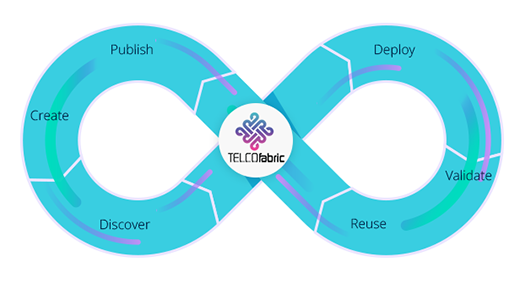
This allows useful work to survive beyond an individual project and gives the next team a stronger starting point.
B-Labs: Validation & Trust
B-Labs adds a validation and interoperability dimension. Selected members of TelcoFabric contribute testing, benchmarking, integration and community-support activities in realistic R&D environments. Validation is most useful when it captures versions, environment, test conditions and limitations. That context helps another organisation judge whether an artifact is relevant to its own system.
An artifact’s presence on TelcoFabric or a B-Labs designation is not, by itself, production acceptance for a specific network. Production readiness must still be assessed against the requirements and operating conditions of the intended deployment.
The Open Source Continuum
Together, the three layers support a continuous model:
- MX-PDK platforms: Production & execution to integrate, automate, deploy and operate.
- TelcoFabric Online Portal: Discovery & collaboration by publishing, discovering and reusing innovation.
- B-Labs Members: Validation & trust by tests, benchmarks and building evidence.
They connect into a wider loop:
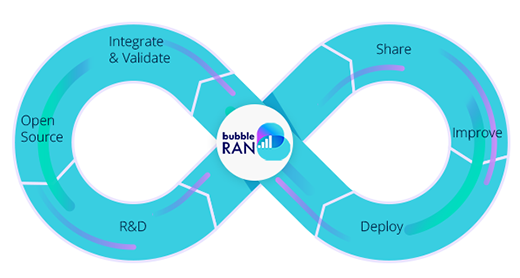
This is the BubbleRAN Open Source Continuum in practice. It is also where our approach goes beyond packaging open-source software: we connect innovation, continuous engineering, productisation, validation, deployment and ecosystem feedback.
Open source is the foundation. Production-grade engineering is the bridge. The ecosystem is the multiplier.
Further reading
- Visit TelcoFabric portal - telco artifacts for faster innovation
- Compare our products dedicated to forward looking telco R&D - MX-PDK family
- Contact us today to discuss how your teams can benefit from our openness strategy